The Power of the Number Seven
Ah yes – humans love the number Seven.
Before telescopes, people could track seven moving lights in the sky. These became the basis for the seven-day week and a lot of “cosmic order” thinking.
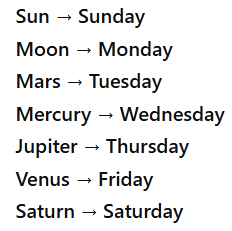
The seven classical “planets” known in antiquity (Sun, Moon, Mars, Mercury, Jupiter, Venus, Saturn) were linked to the seven days of the week in Greco-Roman astrology and later adopted across Europe.
Each day is ruled by one of these celestial bodies.
Once a culture links seven to the structure of the heavens, it’s an easy jump to link seven with the structure of the human being.
You see it everywhere:
- seven colours of the rainbow (a perceptual grouping, not a strict physical rule)
- seven notes in the basic musical scale (we will talk about the number 12 another time)
- seven-step teaching systems
Using seven makes a system feel complete but manageable.
Across traditions, seven becomes a shorthand for:
- a full cycle
- transformation
- passage from material → spiritual
So when a healing model uses seven layers, seven centers, or seven stages, it quietly signals: “This describes the whole journey of a human being.”
There’s a practical brain reason too. Humans comfortably process about 5–9 items at once. Seven lands right in the middle.

Across cultures and centuries, healing traditions have repeatedly organised the human experience around the number seven.
Whether describing layers of the body, stages of transformation, or dimensions of well-being, these systems use seven as a way to express completeness – a full arc from physical survival to spiritual integration.
The pattern appears in ancient medical theories, contemplative practices, and modern holistic health models alike, suggesting that seven functions less as a literal measurement and more as a symbolic framework for understanding balance, growth, and the interconnected nature of health.

Why health systems especially love it
Health models try to unify body, mind, and meaning. Seven conveniently:
- connects to the cosmos
- fits human memory
- symbolises wholeness
That combo makes a system feel natural, intuitive, and profound – even when the number itself is more symbolic than biological.
Big picture pattern
Across cultures, “7” is used as a teaching structure more than a biological discovery. It helps organise complex ideas into memorable systems:
- Symbolic systems: meaning & energy
- Traditional body systems: functional balance
- Lifestyle systems: behavior & context
The number seven shows up in spiritual, traditional, and alternative health systems all over the place. Here are the main health or wellness modalities that explicitly organise around “seven":
Symbolic / Energetic Health Models
These describe health through meaning, balance, and subtle energy rather than measurable anatomy.
👉 What these share: Health = harmony, alignment, and meaning.
Traditional Medical / Physiological Models
These try to describe how the body is organised, but through traditional medical theory rather than modern biomedicine.
👉 What these share: Health = proper nourishment, structure, and internal balance.
Psychological / Lifestyle Health Frameworks
These organise health around behavior, emotion, and life context.
👉 What these share: Health = how you live, feel, and relate.
Seen across time, the recurring “seven” in healing systems reflects humanity’s urge to map wholeness in a way that’s memorable, meaningful, and actionable. From ancient physiological models and emotion–body frameworks to modern lifestyle and energy maps, each uses seven as a bridge between structure and experience. Within this lineage, Twin Streams Healing can be understood as drawing on that integrative impulse – bringing together body, mind, and subtle awareness into a coherent pathway for balance and transformation – less about the number itself and more about guiding people through a complete arc of restoration and growth.
To find out more – contact us for a FREE 15 minute mini-consultation.
Next week's Blog we will look at Living Colour: Introducing CRR Readings.
If there is something in this Blog that you would like to know more about, feel free to use the comment section below to suggest future Blog content.
Add comment
Comments