Genealogy vs Family History: Two Ways of Understanding the Past
When people begin exploring their ancestry, they often use the terms genealogy and family history interchangeably. While the two are deeply connected, they are not identical. Each represents a different approach to discovering, preserving, and understanding the lives of those who came before us. Genealogy focusses on documented lineage and factual relationships, while family history emphasises narrative, context, and lived experience. Together they form a fuller, richer picture of heritage – but each also stands confidently in its own space.
Understanding the distinction between genealogy and family history helps clarify how we reconstruct the past and why both perspectives are essential.

What Is Genealogy?
Genealogy is the systematic study of family lineage and biological relationships across generations. Its primary goal is to identify individuals, establish connections between them, and verify those connections using reliable evidence. A genealogist asks structured questions: Who were a person’s parents? Where did they live? When were they born, married, and buried? What documents confirm these facts?
Genealogy relies on records. Birth and death certificates, census data, marriage licenses, immigration records, church registers, land deeds, wills, and military files serve as the foundation of genealogical research. Increasingly, DNA analysis also plays a role in confirming relationships and uncovering unknown connections.
The discipline values accuracy, documentation, and proof. Professional genealogists often follow formal research standards, carefully citing sources and resolving conflicting information before drawing conclusions. Their work produces family trees, pedigree charts, and verified timelines.
In essence, genealogy builds the structural framework of ancestry. It establishes who belongs where in the chain of generations.

Pros of Genealogy
- High reliability: Emphasis on documented evidence creates trustworthy conclusions.
- Clear lineage structure: Relationships are mapped precisely, making ancestry easier to understand.
- Research discipline: Established methods provide consistency and credibility.
- Problem-solving power: Skilled genealogists can uncover hidden connections and correct errors in family lore.
Cons of Genealogy
- Limited emotional context: Names and dates alone rarely convey personality or experience.
- Technical demands: Research methods, archival work, and source evaluation require skill and patience.
- Potentially incomplete understanding: Documents show events but not always motivations or feelings.
- Time-consuming verification: Confirming accuracy often involves extensive cross-checking.
Genealogy answers foundational questions about identity – but it does not fully capture the lived reality behind those facts.
What Is Family History?
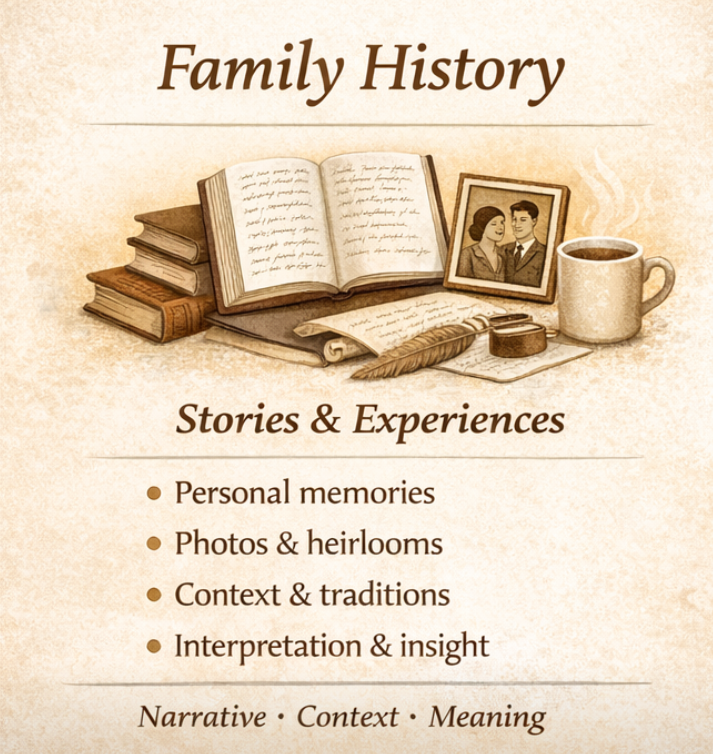
Family history explores the human story behind the lineage. Rather than focusing solely on relationships and records, it seeks to understand how ancestors lived, what they experienced, and how their lives were shaped by their environments.
A family historian gathers oral traditions, letters, diaries, photographs, heirlooms, recipes, customs, and personal memories. They examine social conditions, cultural influences, occupations, migrations, and community life. Where genealogy identifies that an ancestor lived in a particular place at a particular time, family history explores what daily life in that place might have been like.
Family history transforms data into narrative. It connects individuals to broader historical events and social contexts, revealing how ordinary lives intersected with larger forces such as war, economic change, migration, or cultural transformation.
In simple terms, family history gives personality and meaning to ancestry.
Pros of Family History
- Emotional depth: Stories create connection and empathy across generations.
- Cultural preservation: Traditions, values, and lived experiences are recorded and shared.
- Creative expression: Writing, storytelling, and multimedia approaches make research accessible.
- Holistic perspective: Individuals are understood within their social and historical environments.
Cons of Family History
- Risk of inaccuracy: Memories and oral accounts can contain errors or bias.
- Less standardized methods: Without strict research protocols, findings may be difficult to verify.
- Selective memory: Some experiences are remembered while others are forgotten.
- Narrative interpretation: Stories may emphasize meaning over factual certainty.
Family history answers questions about experience and significance – but without genealogical evidence, those stories may lack firm grounding.
Standing in Their Own Space
Genealogy and family history serve distinct purposes and operate in different intellectual spaces. Genealogy is analytical and evidence-driven. Family history is interpretive and narrative-driven. Each discipline has its own tools, priorities, and outcomes.
Genealogy focuses on proof. Its success is measured by accuracy and documentation. It is especially valuable in legal matters, academic research, and the correction of historical records.
Family history focuses on understanding. Its success is measured by insight and connection. It preserves identity in a way that resonates emotionally and culturally.
A genealogist might document that an ancestor immigrated in 1905.
A family historian might explore the reasons for that journey, the challenges faced upon arrival, and the impact on future generations.
Both perspectives are valid, but they answer different kinds of questions. One establishes the framework of lineage; the other reveals the human experience within that framework.
Where Genealogy and Family History Blend
Although genealogy and family history can be distinguished, they naturally complement each other. The most meaningful understanding of ancestry emerges when both approaches are combined.
Genealogy provides structure. Family history provides substance. Together they transform isolated facts into a living portrait of the past.
When the two blend, several important outcomes occur:
- Verified Narratives
Stories gain credibility when supported by documented evidence. A tale of hardship becomes more powerful when confirmed by records of migration, occupation, or historical conditions. - Contextualized Facts
Records become more meaningful when placed within cultural and historical frameworks. A simple census entry becomes a window into social reality. - Deeper Engagement
People connect more strongly to heritage when it includes both factual accuracy and emotional depth. - Preservation for Future Generations
Documentation ensures reliability, while storytelling ensures relevance and memory. - Comprehensive Identity
A complete understanding of ancestry includes both lineage and lived experience.
In this blended space, genealogy and family history are not competing approaches but collaborative ones. Each fills the gaps left by the other.

The Value of Both Perspectives
Recognizing the difference between genealogy and family history encourages balance. It reminds researchers to respect evidence while also honoring narrative. It prevents the past from becoming either a sterile list of names or an unverified collection of stories.
Ancestry is both scientific and humanistic. It requires investigation, interpretation, and empathy. Genealogy safeguards truth; family history safeguards meaning.
Together they preserve not only who our ancestors were, but how they lived and why their lives matter.
In the end, the past is not just a sequence of generations – it is a tapestry of relationships, experiences, and stories. Genealogy provides the threads. Family history weaves them into something that can be understood, remembered, and passed forward.
To find out more – contact us for a FREE 15 minute mini-consultation.
Next week's Blog we will look at Discovering Your Soul Life History Through the Akashic Records.
If there is something in this Blog that you would like to know more about, feel free to use the comment section below to suggest future Blog content.
Add comment
Comments