The Energetic Language of the Body: Exploring Muscle Testing and Its Many Forms
In the realm of holistic healing, there is a quiet yet profound method of communication that bridges the conscious and subconscious, the physical and the energetic.
Muscle testing – often referred to as applied kinesiology in some contexts – is one such modality. It offers a way to listen to the body’s innate intelligence, revealing subtle imbalances and energetic truths that may not be immediately accessible through the thinking mind alone.
At its core, muscle testing is based on a simple premise: the body responds to stimuli – whether physical, emotional, or energetic – with measurable changes in strength or resistance. When aligned with truth or supportive energy, the body tends to remain strong. When faced with stress, imbalance, or incongruence, it may momentarily weaken. This binary response becomes a language, a way for the body to “speak.”
The Foundations of Muscle Testing
Muscle testing works with the understanding that the body is not just a mechanical system, but an energetic one.
Every thought, belief, substance, or experience carries a vibrational signature. The nervous system, acting as a bridge between the physical and energetic layers, responds instantly to these inputs.
When a practitioner applies gentle pressure to a muscle – commonly the arm – and asks the body a question or introduces a stimulus, they observe the response. A stable, resisting muscle indicates alignment or a “yes,” while a weakening or dropping response may indicate stress or a “no.”
This is not about physical strength in the traditional sense. Rather, it is about neurological and energetic coherence. Even the strongest person can show a momentary weakening response when exposed to something their body perceives as stressful.
A Tool for Awareness and Alignment
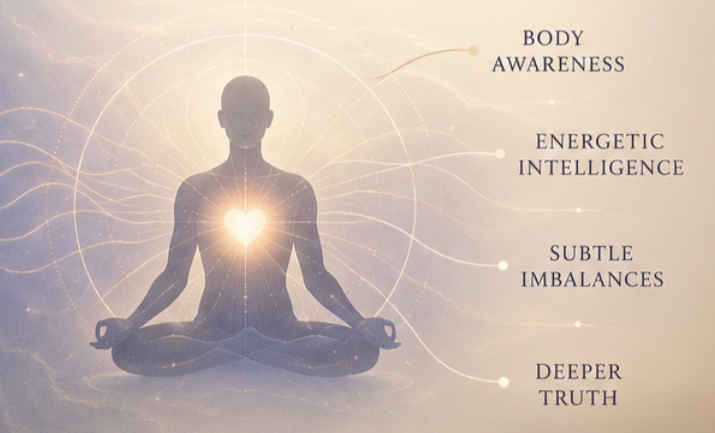
Muscle testing is not about diagnosing in the conventional medical sense. Instead, it serves as a tool for awareness – helping individuals tune into what supports or disrupts their wellbeing. It can be used to explore food sensitivities, emotional patterns, environmental stressors, and even limiting beliefs.
In a healing context, it becomes a way to navigate the unseen. Practitioners often use it to guide sessions, determine priorities, and identify the root of imbalances. For individuals, it can be empowering – offering a direct line of communication with their own body wisdom.
Different Types of Muscle Testing
Over time, various methods of muscle testing have evolved. While they all stem from the same foundational principle, each offers a slightly different approach or application.
The Role of Intention and Neutrality
A key aspect of effective muscle testing is neutrality. The practitioner – or individual – must remain as unbiased as possible, allowing the body’s response to come through without influence from expectations or desired outcomes.
Intention also plays a significant role. Clear, focused questions yield clearer responses. Vague or emotionally charged questions can create confusion in the signal.
Grounding practices, such as deep breathing or centring, are often used before testing to ensure a stable and coherent starting point.
A Bridge Between Worlds
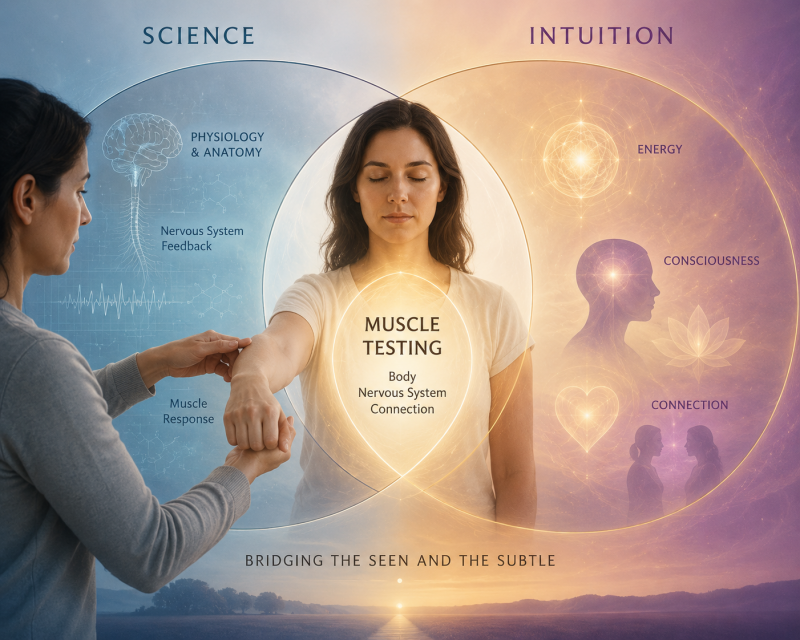
Muscle testing sits at an interesting intersection between science and intuition. While it engages the physical body and nervous system, it also touches on the more subtle aspects of energy, consciousness, and connection.
For some, it is a practical tool for decision-making and self-care. For others, it becomes part of a deeper healing journey – one that invites trust in the body’s wisdom and a willingness to listen beyond the surface.
A Gentle Perspective
As with any modality, muscle testing is not about absolute answers or rigid truths. It reflects the body’s response in a given moment, influenced by a wide range of factors including stress levels, hydration, and emotional state.
Approaching it with curiosity rather than certainty allows for a more balanced and respectful relationship with the process. It is a guide, not a rulebook.
Here are some links to muscle testing videos:
Muscle Testing Overview: https://www.youtube.com/watch?v=yIJVopGPth0
Muscle Testing Yourself: https://www.youtube.com/watch?v=ALJbps8TaYM
Muscle Testing Another Person: https://www.youtube.com/watch?v=j_wBnZynQoQ
Muscle Testing Demo: https://www.youtube.com/watch?v=hUbsSnARueA&list=PLVLagCFJ0INfF9GYp8qReyMrH8Rl_gmOB&index=7
You may wish to explore which method works best for you. A quick Youtube search will provide you with many examples of Muscle testing, how it works, and how to do it yourself.
Closing Thoughts
Muscle testing offers a unique way to engage with the body’s energetic language. Whether used in a professional setting or as a personal practice, it invites a deeper awareness of what supports and what disrupts our natural state of balance.
In a world that often prioritises external information, this practice gently turns attention inward – toward the subtle signals that are always present, waiting to be noticed.
By learning to listen, we begin to cultivate a relationship with our own inner guidance – one that is grounded, responsive, and deeply connected to the rhythms of our being.
At Twin Streams Healing, muscle testing becomes part of a wider conversation with the body – woven alongside energy work, intuitive guidance, and a deep respect for each person’s unique rhythm. Rather than standing alone, it flows as one stream within a holistic approach, helping to gently uncover where energy may be held, scattered, or ready to shift.
Through this integrative lens, the body is not something to be “fixed,” but listened to – honoured as a wise and responsive system that already knows the way back to balance.
To find out more – contact us for a FREE 15 minute mini-consultation.
Next week's Blog we will look at Why Energetic Healing Is Becoming More Relevant by the Day.
If there is something in this Blog that you would like to know more about, feel free to use the comment section below to suggest future Blog content.
Add comment
Comments