Plant Vibrational Patterns: The Subtle Language of Living Plants
Plants have long been recognised as healers within traditional wisdom systems, yet modern science is only beginning to explore the deeper energetic dynamics that may explain this relationship. Beneath their quiet presence lies a complex world of movement, communication, and subtle vibration. Every plant participates in a dynamic field of energy – responding to light, sound, touch, and environmental conditions through patterns of oscillation that could be described as vibrational signatures.

Understanding plant vibrational patterns opens a doorway into a different way of perceiving nature. Instead of seeing plants merely as biological structures, we begin to recognise them as living resonant beings that interact continuously with the world around them.
The Living Frequencies of Plants
All living organisms generate measurable frequencies. Within plants, these vibrations arise from several natural processes occurring simultaneously.
Plants produce bioelectric signals that travel through their tissues as part of their internal communication system. When a plant experiences environmental changes – such as light variations, touch, or temperature shifts – small electrical impulses move through the plant body, coordinating responses between roots, stems, and leaves.
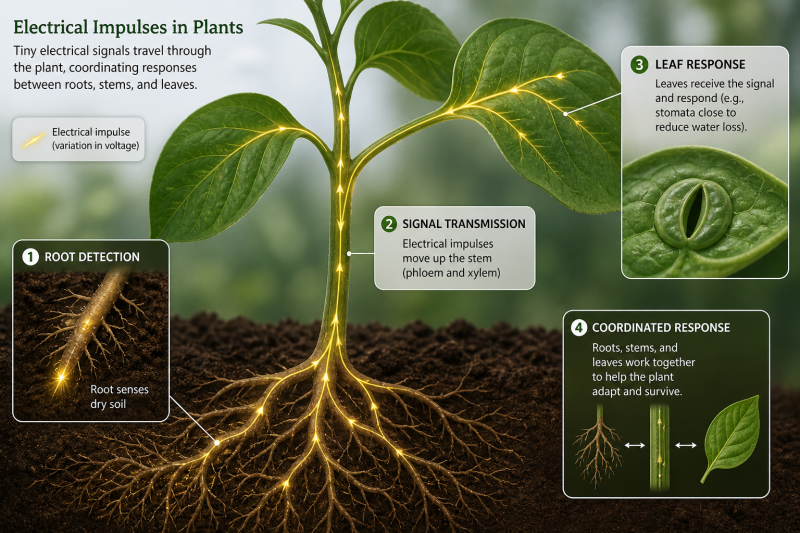
These signals function somewhat like a distributed communication network, allowing plants to adapt intelligently to their environment. Roots may alter their growth patterns when sensing water or nutrients, while leaves adjust their orientation toward sunlight to maximise photosynthesis.
In addition to electrical activity, plants also generate mechanical vibrations. Sap moves rhythmically through vascular systems, cells expand as new growth occurs, and leaves respond to wind currents. Even pollination can involve vibration – some bees use a technique known as buzz pollination, vibrating flowers at specific frequencies to release pollen.
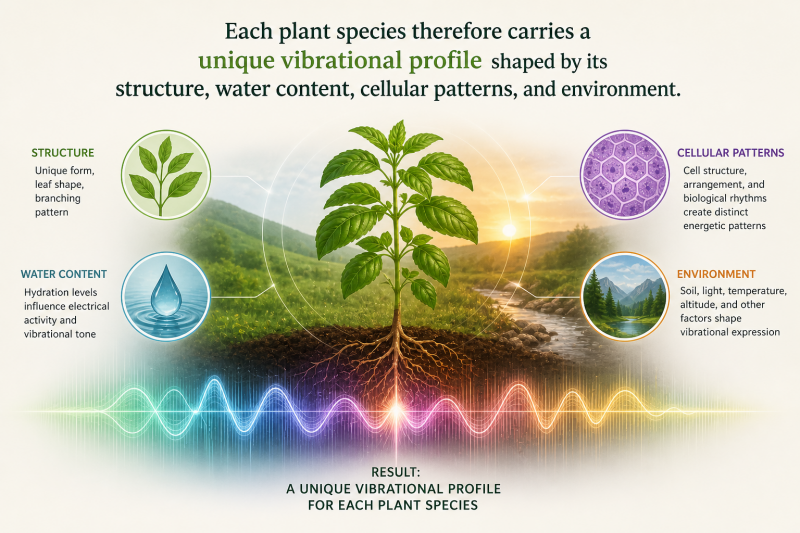
Each plant species therefore carries a unique vibrational profile shaped by its structure, water content, cellular patterns, and environment.
Resonance in the Natural World
The concept of resonance helps explain why plant vibration matters. Every physical object has a natural frequency at which it resonates most easily. When another vibration matches that frequency, resonance occurs, amplifying the effect.
This principle can be seen throughout nature – from musical instruments to architectural structures – and plants are no exception. Their tissues, fluids, and cellular frameworks all contribute to their natural resonance.
Nature itself seems organised according to vibrational harmony. Many plant forms follow sacred geometric patterns such as spirals and fractals. The arrangement of sunflower seeds, pinecone scales, and leaf growth often follows the Fibonacci sequence, suggesting that plants organise themselves according to underlying harmonic principles.
From this perspective, plant growth may not simply be chemical or genetic – it may also be vibrationally guided.
Cymatics and Visible Vibrations
A fascinating field called cymatics explores how sound vibrations create geometric patterns in materials such as sand, powder, or water. When frequencies are played through a medium, intricate symmetrical shapes emerge.
Because plants are composed largely of water, researchers and vibrational thinkers have speculated that similar processes may occur within living tissues. Vibrational forces may help shape plant structures, influencing the development of leaves, petals, and seeds.
While this idea remains exploratory, it resonates with a deeper observation: nature consistently organises itself through patterns of rhythm, symmetry, and flow.
The Biofield of Plants
Beyond measurable electrical signals and mechanical vibrations, many traditions describe plants as having a biofield – a subtle energetic field that surrounds and interacts with living organisms.
Concepts of plant energy appear in many cultural healing systems, including traditional herbalism, Indigenous plant wisdom, and Eastern medical traditions. In these frameworks, plants are understood not only as chemical medicines but also as energetic allies capable of influencing emotional and spiritual states.
Modern science is beginning to investigate related phenomena such as biophoton emissions, tiny bursts of light produced by living cells. Plants emit these ultra-weak photons during metabolic processes, suggesting that life may involve subtle forms of light communication.
These discoveries hint that plants participate in complex energetic interactions that we are only starting to understand.
Plant Vibrations and Flower Essences
One of the most practical applications of plant vibrational patterns can be found in flower essence therapy.
Unlike herbal medicine, which relies on the chemical constituents of plants, flower essences work with the energetic imprint of a flower. The traditional preparation method involves floating freshly picked blossoms on water in sunlight, allowing the water to absorb the plant’s vibrational pattern.
This process creates a remedy believed to carry the subtle energetic signature of the plant.
Systems such as those developed by the Bach Centre and the First Light Flower Essences of New Zealand use these vibrational remedies to support emotional and spiritual wellbeing.
Different plants are associated with different emotional themes – courage, peace, confidence, resilience – reflecting the idea that each plant expresses a unique energetic quality.

Water as the Messenger
Water plays an essential role in transmitting plant vibration. Because water molecules are highly responsive to frequency and environmental influences, they serve as an ideal medium for carrying subtle energetic patterns.
Researchers exploring water structure have observed that water can form intricate patterns when frozen or exposed to various stimuli. One contemporary investigator in this area is Veda Austin, who studies how water crystallisation patterns appear to reflect different energetic influences.
These observations raise fascinating questions about the relationship between plants, water, and vibration.
A Vibrational Partnership with Plants
When we begin to view plants through the lens of vibration, our connection with nature becomes richer and more reciprocal. Plants are no longer passive scenery; they are participants in an energetic conversation.
Gardens, forests, and wild landscapes become spaces of subtle resonance where human and plant frequencies meet.
Simple practices – walking in nature, tending a garden, preparing herbal teas, or working with flower essences – can help us reconnect with these natural rhythms.
A Closing Reflection from Twin Streams Healing
At Twin Streams Healing, the understanding that everything carries a vibrational signature lies at the heart of many healing modalities. Flower essences, energy work, and intuitive practices all work with the subtle patterns that shape our emotional and energetic lives.
Plants offer gentle guidance in this process. Their vibrational patterns remind us that balance, resilience, and harmony are natural states within the living world. When we work with plant energies – whether through flower essences, meditation, or simple presence in nature – we begin to re-tune ourselves to the frequencies of the earth.
In this way, plants become not only sources of beauty and medicine, but also teachers of resonance, helping us rediscover the quiet harmony that flows through all living things
To find out more – contact us for a FREE 15 minute mini-consultation.
Next week's Blog we will look at Peace Within: Exploring the Peace Within Affirmation Cards from Yoga & Oils.
If there is something in this Blog that you would like to know more about, feel free to use the comment section below to suggest future Blog content.
Add comment
Comments